
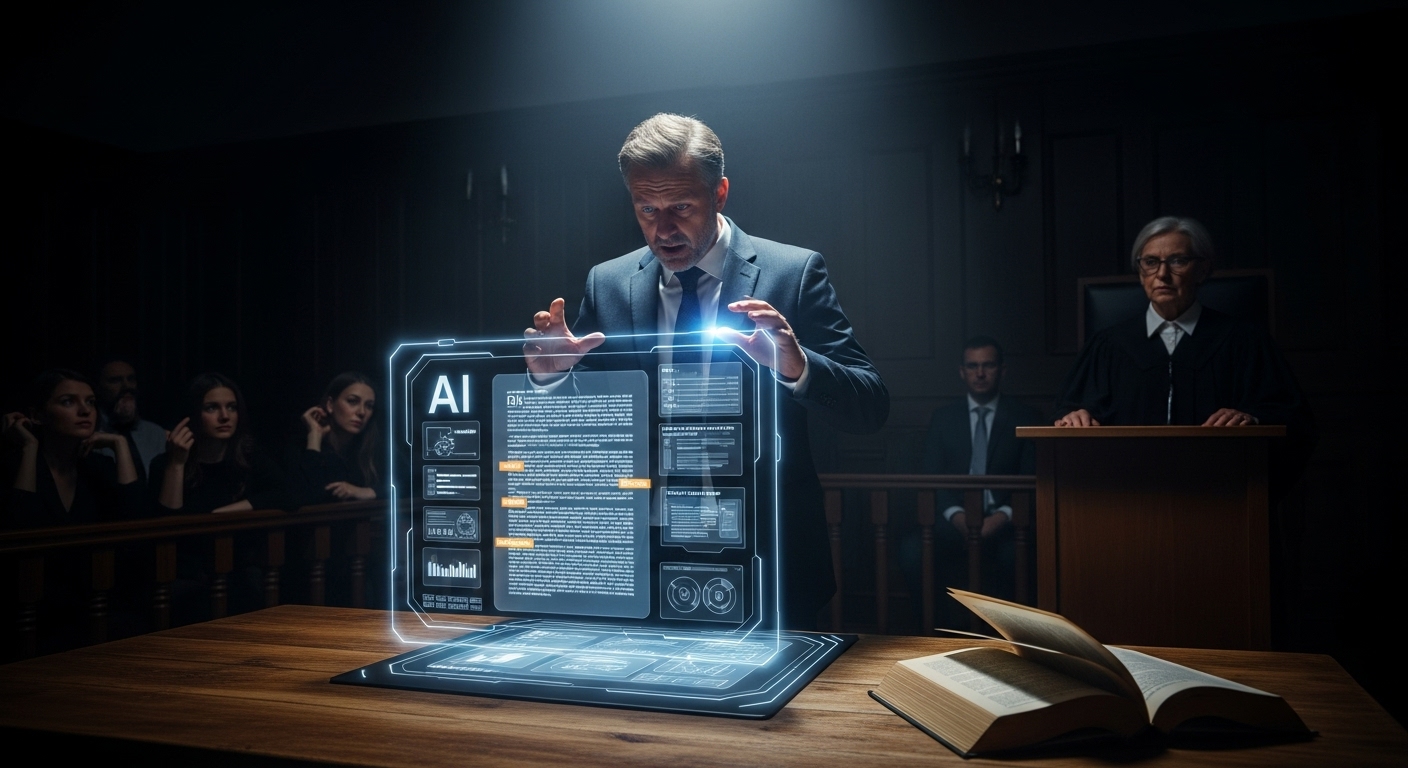
The rapid development of artificial intelligence (AI) technologies has led to an expansion in their use within the legal professions, particularly in the field of legal practice. These technologies are now employed in legal research, drafting memoranda, and analyzing judicial precedents. However, this new reality has generated emerging legal issues concerning the determination of the extent of a lawyer’s liability for professional errors that may arise as a result of reliance on artificial intelligence systems.
This research aims to clarify the legal basis of a lawyer’s liability in this context, identify the forms of professional error, the standard for assessing such error, and the limits of the causal relationship, all in light of the general rules of civil liability and the principles established by legal doctrine and judicial decisions.
Introduction
Artificial intelligence is no longer merely a theoretical concept or a supportive technical tool; rather, it has become a practical reality deeply embedded in the daily structure of legal work. This development has had a significant impact on the legal profession, which now has access to tools capable of processing vast amounts of data and deriving legal solutions in record time.
Despite its importance, this development raises fundamental questions regarding the lawyer’s liability, particularly in cases where a professional error results from the use of such technologies. Can a lawyer invoke artificial intelligence to deny fault? Or does liability remain attached to the lawyer as the ultimate legal decision-maker?
This constitutes the central issue that this research seeks to address.
Chapter One: The Legal Nature of the Use of Artificial Intelligence in the Legal Profession
In principle, the use of artificial intelligence is not in itself unlawful. Legally, it is classified as an auxiliary technical means falling within the scope of tools that a lawyer may use in the performance of professional duties, similar to legal databases or case management software. Accordingly, artificial intelligence does not rise to the status of a legal actor, nor does it possess the capacity of a representative or agent; rather, it remains a technical tool subject to the lawyer’s supervision and control.
A lawyer may not delegate essential legal decisions or the drafting of final defense positions to a technical tool without conscious human review. Nor may artificial intelligence be used in a manner that breaches the duty of confidentiality or exposes client data to unsafe circulation or storage. Thus, lawful use is use that is constrained by verification, review, and the preservation of confidentiality.
The use of artificial intelligence does not result in the transfer of professional liability from the lawyer to the technical tool or to its developer. The lawyer remains fully responsible for the accuracy of submissions made to the court, the validity of cited precedents, and the integrity of the data processed. Unverified reliance on AI outputs constitutes a form of breach of the professional duty of care if it leads to misleading the court or harming the client’s interests.
Accordingly, a lawyer’s reliance on artificial intelligence does not alter the nature of the obligation owed to the client, which remains an obligation to exercise due professional care, as established in doctrine and jurisprudence.
Chapter Two: The Legal Basis of the Lawyer’s Liability for Errors Arising from Artificial Intelligence
A lawyer’s liability in this area is governed by the general rules of civil liability, whether contractual liability arising from breach of the agency contract, or tort liability where harm is inflicted upon third parties.
This basis is founded on a principle firmly established in doctrine and case law, namely that a lawyer’s obligation toward the client is an obligation to exercise due care. The lawyer must exert a reasonable level of effort and professional diligence in fulfilling this obligation, regardless of whether the intended result is achieved. Where the mandate is for consideration, such care is assessed by reference to the conduct of an ordinarily competent professional, requiring the lawyer to exert maximum effort in defending the client’s rights within the limits dictated by the interests of the case and the requirements of confronting opposing parties with legal arguments and evidence.
Accordingly, an error produced by artificial intelligence is attributed to the lawyer if it is established that the lawyer relied upon it improperly or without sufficient verification.
Historically, lawyers have relied on others in preparing pleadings and memoranda, whether natural persons (junior lawyers, contracted legal researchers, law students) or impersonal sources lacking legal personality (legal encyclopedias, judicial and legal databases). Such reliance is not inherently blameworthy.
However, general rules and professional custom impose a supervisory duty on lawyers over such auxiliary factors to ensure the accuracy of what is presented to the court.
Chapter Three: Forms of Professional Error Arising from the Use of Artificial Intelligence
Professional error in this context may take several forms, including:
First: Unjustified Reliance on Automated Outputs
This occurs when a lawyer treats AI-generated results as established legal facts without review or scrutiny.
A notable example is Mata v. Avianca Inc. before the U.S. District Court for the Southern District of New York in 2023, presided over by Judge Castel. In this case, the plaintiff’s attorneys relied on ChatGPT for legal research, which generated five non-existent cases containing fabricated quotations and citations that were submitted to the court without verification.
The court found the plaintiff’s attorneys culpable for relying on AI outputs without reviewing and verifying their content, stating:
“The submission of fake judicial opinions causes serious harm. The opposing party wastes time and money exposing the deception; the court’s time is wasted at the expense of more important tasks; the client may be deprived of arguments based on genuine precedents. There is also potential harm to the reputation of judges and courts falsely attributed with fictitious opinions, and to parties falsely associated with imaginary conduct. This conduct undermines trust in the legal profession and the American judicial system, and may encourage future litigants to challenge judicial rulings by claiming doubt as to their authenticity.”
In a local incident before the Dispute Resolution Center of the Qatar International Court, Case No. CTFIC0033/2025, a defense document submitted by a lawyer contained references to judgments and precedents intended to support the defense. Upon review, the court found no record of these authorities in recognized judicial records or databases. After further inquiry, the lawyer admitted that these references had been generated through AI-based digital research tools without verification.
The court concluded that such conduct, regardless of intent, undermines the duty of candor owed to the judiciary. The requirements of professional care oblige a lawyer to verify the authenticity of every judgment or reference before relying upon it. Resorting to artificial intelligence does not create grounds for exemption from liability; the lawyer remains responsible for ensuring the accuracy and integrity of all materials submitted to the court.
Second: Negligence in Verifying the Currency of Texts and Judgments
Some systems may rely on outdated data, leading to reliance on repealed legislation or obsolete judicial interpretations.
In England and Wales, Lady Justice Dame Victoria Sharp, President of the King’s Bench Division, in R (on the application of Ayinde) v. London Borough of Haringey [2025] EWHC 1383 (Admin), emphasized the need for courts to rely on the integrity and professionalism of advocates. In paragraphs (7) to (9), she stated that those who use artificial intelligence for legal research bear a professional duty to verify the accuracy of such research by consulting reliable sources before using it in professional work, whether in advising clients or appearing before the court.
She further warned of the serious consequences for the administration of justice and public confidence in the judicial system if artificial intelligence is misused, calling for practical and effective measures by those with leadership responsibilities within the legal profession and by regulatory bodies to ensure that all providers of legal services understand and comply with their professional and ethical obligations when using AI.
Third: Breach of Confidentiality
The confidentiality of the lawyer–client relationship is a cornerstone of the legal profession, founded on complete trust that disclosed facts and documents will remain protected from unlawful disclosure or circulation.
Professional secrecy is no longer limited to spoken words or paper documents; it now extends to digital data, electronic communications, digitally stored case files, and any information capable of identifying the client or their legal position. Entering such data into unsecured digital platforms or AI tools that do not guarantee non-storage or non-reuse of content constitutes a modern form of breach of confidentiality, even absent express intent to disclose.
Modern legal scholarship has emphasized that the use of advanced technologies does not relieve lawyers of their traditional duties; rather, it imposes a heightened obligation of verification and caution. Some courts in comparative legal systems have begun to regard the entry of client data into unsecured platforms as a breach of professional trust, given the resulting erosion of the confidence upon which justice depends.
Chapter Four: The Standard for Assessing Error and the Causal Relationship
Doctrine and jurisprudence have established that a lawyer’s error is not assessed by reference to an abstract ordinary person, but by reference to the ordinarily competent lawyer of similar standing and experience practicing under comparable circumstances. The question is whether the lawyer deviated from the expected conduct of a vigilant and prudent professional who adheres to the principles and rules of the profession.
The mere loss of a case or rejection of claims does not constitute professional error so long as the lawyer exerted reasonable effort, observed procedural deadlines, and relied on serious legal grounds. Error arises only where there is clear negligence, such as failure to file a claim on time, omission of a substantive defense, gross ignorance of settled legal rules, or submission of incorrect information to the court.
Since the lawyer’s obligation is one of due care, liability is limited to the extent to which this care was respected. The burden of proof rests with the client, who must demonstrate the aspects of professional negligence and establish that such negligence breached the required duty of care.
In the context of this study, liability arises only where damage occurs and a direct causal link exists between the error and the damage, such that the lawyer’s reliance on artificial intelligence constitutes the effective cause of the harm.
Conclusion
This research concludes that artificial intelligence, despite its advanced capabilities, does not exempt lawyers from professional liability nor diminish their duty of care. The lawyer remains the controlling legal mind, the ultimate decision-maker, and the primary party responsible before both client and court.
Accordingly, the prudent use of artificial intelligence requires its integration within the professional and ethical framework of legal practice, as an auxiliary tool rather than a substitute for human legal judgment.
References
-
Abdel Razzaq Ahmed Al-Sanhouri, Al-Wasit in the Explanation of Civil Law, Part I, Dar Ihya’ Al-Turath Al-Arabi, Beirut, 1998.
-
Mohamed Abdel Zaher Hussein, Civil Liability of the Lawyer toward the Client, Legal Library, Cairo, 1991.
-
Ahmed Abu Al-Wafa Salama, Theory of Obligation in Civil Law, University Publications House, Alexandria, 2005.
-
Rifaat Khafaji, “Interpretation of Gross Professional Error,” Lawyers’ Journal, Egypt, Vol. 39, Issue 1.
-
Sami Azer Jibran, “Reflections on the Legal Profession,” Lawyers’ Journal, Egypt, Vol. 51.
-
Ahmed Suleiman Hassan, The Lawyer’s Liability for Professional Errors, PhD Dissertation, Ain Shams University, 2008.
-
Website of the Qatar International Court: https://www.qicdrc.gov.qa/ar/judgments
Written by:
Ihab El-Sayed Nayel
Senior Legal Consultant
Master’s Degree in Judiciary and Sharia Policy
Monday, 24 Jumada al-Akhirah 1447 AH